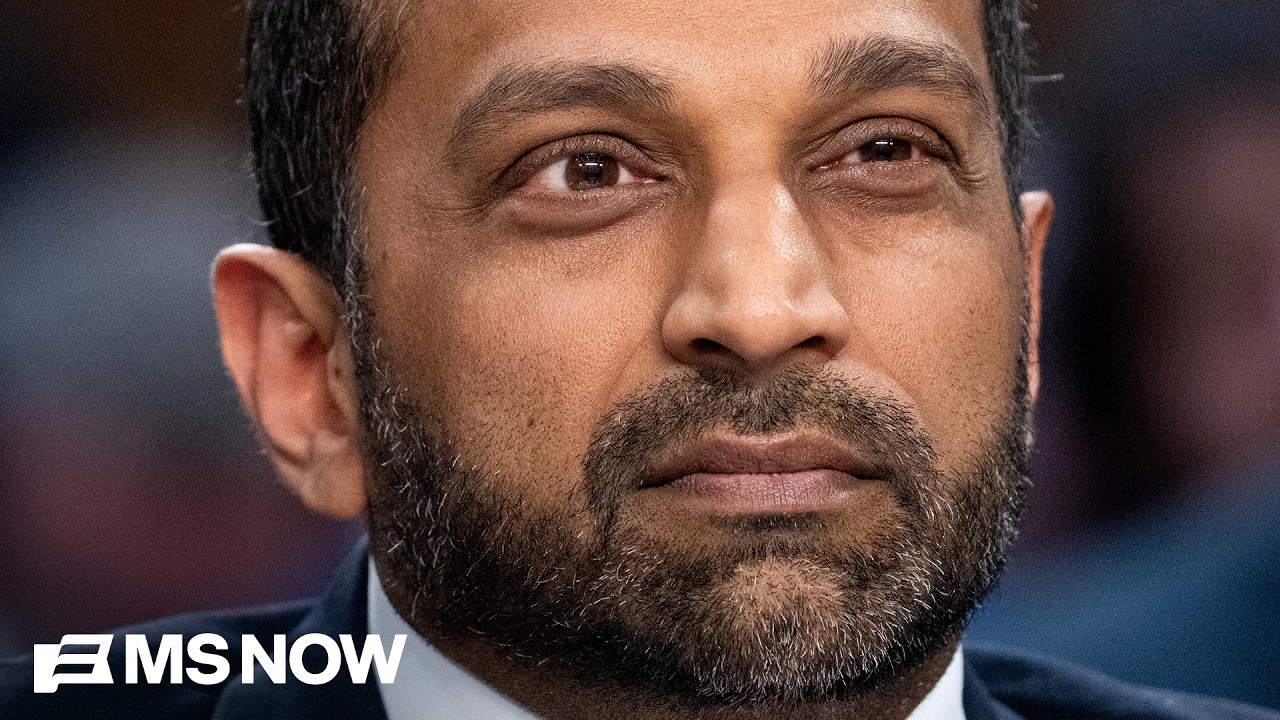
While Chairman Chuck Grassley leans on FBI data showing record drops in violent crime to shield Patel, the reality on the ground looks more like a fire sale: hundreds of staff departures, relaxed hiring standards for criminals, and a Director accused by Dick Durbin of swapping law enforcement for political retribution and conspiracy theories. Between the bipartisan ire over the Charlie Kirk investigation and the tawdry distractions of government aircraft misuse and drinking allegations, the 'hardline strategy' credited by the administration is being countered by experts who suggest the crime drop is merely a post-pandemic trend, leaving Patel as a figurehead of a crumbling agency.
The debate over Patel's competence has shifted from general mismanagement to a specific, surrealist pivot in FBI hiring: the removal of automatic disqualifications for applicants with histories of bestiality, prostitution, or theft under 18. While Patel wraps this in the nobility of protecting human trafficking victims, the FBI's failure to provide a single data point supporting the frequency of such cases suggests the 'whole person' approach is less about empathy and more about lowering the bar. Meanwhile, the Senate Judiciary Committee has devolved into a playground brawl, with Grassley acting as Patel's time-keeper and Patel dismissing Senator Booker as a 'thug.' As Breitbart dutifully echoes Trump's claims of doubling arrest rates to justify the chaos, the core conflict is no longer just about partisan leadership, but whether the FBI is being intentionally hollowed out to make room for a more 'flexible' breed of agent.
The narrative of 'partisan weaponization' now has a specific, tactical edge: Senator Durbin is pointing to the FBI's handling of shootings involving ICE and Border Patrol agents as evidence of a selective justice system. This transforms the debate from a general critique of Patel's temperament into a question of whether the agency is actively shielding its own ideological allies. While Mediaite continues to lean into the tabloid allure of Patel's Italian vacations and drinking habits, the real story is the widening gap between Patel's 'human trafficking' justification for hiring criminals and a leadership style that appears to treat federal law enforcement as a private security detail for the administration's favorites.
The latest coverage is a masterclass in circularity, offering nothing but a playback of the Senate's theatrical dysfunction. Mediaite treats Patel’s Fox News victory lap—where he rebranded Democratic scrutiny as 'radical lunacy' and 'buffoonery'—as news, while CBS and NBC provide the narrative equivalent of a placeholder, merely noting that Patel defended his penchant for hiring the morally flexible. By centering the 'explosive clashes' over the actual substance of the bestiality policy or the statistical validity of the crime drop, the outlets are effectively laundering Patel's aggression as 'results' and reducing a systemic hollowing of the FBI to a series of spicy soundbites.
NBC reports that Kash Patel defended the removal of automatic disqualifications for bestiality during a Senate hearing, claiming the move protects sex trafficking victims while asserting that voluntary offenders remain barred. This coverage is a textbook example of narrative stagnation; by simply recording the back-and-forth between Patel and Senators Kennedy and Durbin, the outlet treats a surreal policy shift as a standard parliamentary debate. Rather than probing the evidentiary void regarding how many trafficking victims actually apply for FBI roles, the reporting settles for a stenographic account of the hearing, effectively reducing a systemic collapse of hiring standards to a mere 'he-said, she-said' exchange.
The stenographic boredom of the previous cycle is finally punctured, not by a sudden surge in journalistic rigor, but by a shift from recording the debate to auditing the premise. While HuffPost and The Nation continue to treat the Senate hearing as a theatrical clash of personalities, the frame has evolved from 'is this policy weird?' to 'is this policy a lie?' The emergence of a direct challenge to the factual basis of Patel's 'human trafficking' defense transforms the narrative from a dispute over hiring standards into a question of whether the FBI Director is fabricating humanitarian crises to justify a systemic lowering of the bar. However, the media's appetite for the absurd remains dominant; Mediaite’s pivot to 'Donkey of the Day' commentary proves that for some outlets, the systemic hollowing of a federal agency is merely a backdrop for the latest viral punchline.
Reason provides a critical factual intervention by leveraging a decade of reporting on human trafficking prosecutions to debunk Patel's central claim. While Patel asserts that traffickers frequently force victims into bestiality to justify the policy shift, Reason notes a total absence of evidence supporting the frequency of such cases. This matters because it strips the 'humanitarian' veneer from the policy, suggesting the rule change isn't based on victim advocacy but is instead a baseless pretext for expanding the applicant pool.
HuffPost and Mediaite exemplify the nadir of oversight reporting, treating a surreal policy shift as a mere script for a comedy routine. By focusing on Senator Kennedy's exasperation and the 'Donkey of the Day' label respectively, they reduce a potential institutional crisis to a series of 'contentious exchanges' and celebrity reactions, effectively ignoring the evidentiary void that should be the center of the story.
The central inquiry now pivots from whether Patel is lying about the humanitarian intent of his hiring policies to whether those policies are even being implemented as he describes them. The Atlantic shifts the frame from a debate over 'compassion' to a direct contradiction of the Director's testimony, suggesting a gap between Patel's public defense and the actual internal rules. By highlighting the failure of the 'coercion' distinction in practice, the coverage moves past the absurdity of the bestiality provision and begins to frame the situation as a potential breach of candor before Congress. This evolution is a necessary correction; it stops treating the hearing as a clash of personalities and starts treating it as a discrepancy in official record, though the media's tendency to bundle this with reports of Patel's drinking habits threatens to slide the story back into the realm of character assassination rather than institutional audit.
The Atlantic introduces a critical factual contradiction: while Patel testified that the bestiality provision was designed to protect victims of coercion, internal sources via CBS News indicate the actual rules make no such distinction. This is a pivotal development because it transforms the narrative from a disagreement over policy wisdom into a question of whether the Director provided false testimony to the Senate Judiciary Committee, moving the stakes from 'bad policy' to 'perjury'.
Coverage previously centered on whether Patel lied to Congress about hiring standards for sex offenders. The focus now returns to the agency's handling of lethal force cases involving federal agents. The Nation reports that Senator Amy Klobuchar questioned Patel on the FBI's failure to cooperate for six months in the shooting deaths of Renee Good and Alex Pretti. This shift moves the narrative from internal personnel policies to the external application of justice and government transparency. The press has successfully pivoted from the absurdity of bestiality rules back to the gravity of state-sponsored violence, provided they don't get distracted by the next viral clip.
Fox News reports FBI Operation Blackout seized 17 billion dollars from global scam compounds
New coverage from 1 outlets
Fox News provides a critical pivot in the narrative by reporting that Operation Blackout has seized approximately $17 billion from foreign scam compounds in Southeast Asia and the Middle East. This [★ 독자적 사실] introduces a concrete operational victory, detailing the seizure of hardware from Cambodia's O’Smach Resort and the prevention of $660 million in domestic losses through Operation Level Up.
By highlighting these results, the coverage moves away from the institutional decay and personnel scandals that dominated previous reports. It replaces the image of a hollowed-out agency with one of a functioning global police force targeting organized crime and protecting senior citizens. This shift effectively counters the ongoing debate over Patel's competence by presenting a high-stakes success that is difficult to dismiss as mere political theater.