The conflict between federal financial oversight and state gambling regulation
The core issue is whether prediction markets function as financial instruments or as sportsbooks. If they are viewed as derivatives, a single federal agency maintains oversight. If they are classified as gambling, they fall under a patchwork of state laws that typically impose stricter age limits and integrity monitoring.
This dispute centers on the ability to police the actual events being bet upon. Federal financial regulators focus on market stability and transparency. State gambling regulators focus on game integrity, such as preventing the manipulation of specific plays or the use of insider medical information to gain an unfair advantage.
Focus on regulatory capture and the tension between integrity and efficiency
Most outlets frame the dispute as a clash between the NFL's desire for control and the efficiency of a national regulatory framework. Fox News and espn.com provide critical depth by reporting that the federal regulator accused the league of attempting regulatory capture and noting the NFL's refusal to sign a cooperation memorandum. These reports engage with the essential question by highlighting that the league's push for state control may be a strategy to maintain direct influence over the markets.
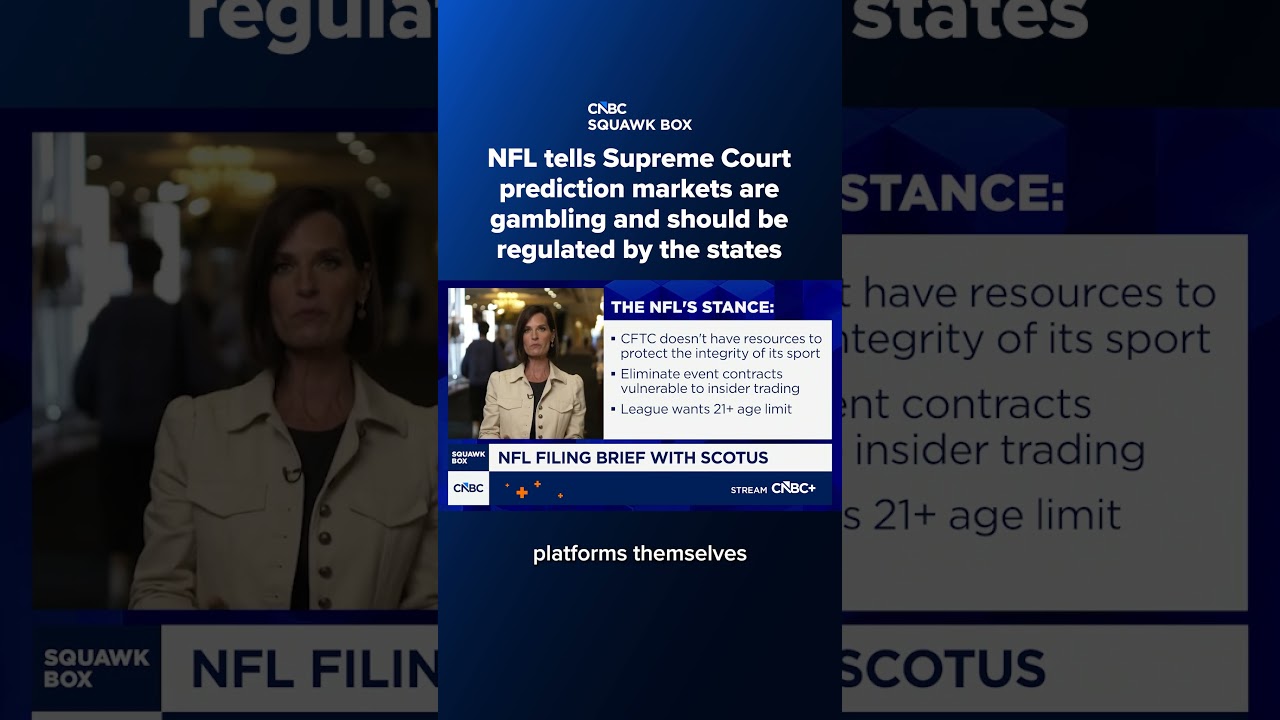
CNBC and Daily Caller focus more on the social and operational risks, such as the minimum betting age and the potential for addiction. While these details provide context on consumer safety, they drift from the central legal question of jurisdiction. The coverage generally succeeds in presenting the antithesis—that a harmonized federal system is superior to fragmented state laws—but lacks a deeper analysis of how state-level integrity monitoring actually differs in practice from federal financial policing.
NFL urges Supreme Court to classify prediction markets as gambling citing 1.8 billion dollar trading volume
New coverage from 5 outlets
The dispute has moved from a general jurisdictional debate to a formal legal battle as the NFL filed an amicus brief urging the Supreme Court to shift oversight to the states. ABC News and Breitbart provide critical scale to this conflict by reporting that NFL-related trades accounted for $1.8 billion of the $3.3 billion total volume on the first Sunday of the season. This data transforms the argument from a theoretical concern over integrity into a matter of managing a massive, concentrated financial interest.
Reason engages with the essential question by questioning the league's motive. It reports that the NFL is asking platforms to remove specific bets that are simultaneously offered by the league's own official partners, DraftKings and FanDuel. This suggests the push for state regulation may be a tool to eliminate competition rather than a pure effort to protect game integrity.
CBS News, Breitbart, and New York Times maintain a more descriptive approach. They highlight the NFL's claims that the CFTC lacks the resources to prevent insider trading, but they omit the contradictory evidence regarding the league's own partners. These reports focus on the requested legal outcome—a Supreme Court ruling—rather than the underlying commercial conflict.
Washington Examiner highlights peer-to-peer trading structure and state tax interests in the Supreme Court dispute
New coverage from 1 outlets
Washington Examiner engages with the essential question by distinguishing the mechanical structure of prediction markets from traditional sportsbooks. It reports that users on these platforms trade against each other rather than against a house, arguing this distinction separates financial exchanges from gambling.
This report further identifies a financial motive behind the push for state oversight, framing the conflict as a turf war over taxes and revenue. By highlighting the financial interests of state gaming commissions, the coverage moves beyond the league's stated concern for game integrity to address the economic incentives of the regulators themselves.