JUSTSUSS AI-powered press divergence analysis
Headline news 2026.10.24 00:25 created · 10.27 20:06 updated
← Card Feed
Reference video

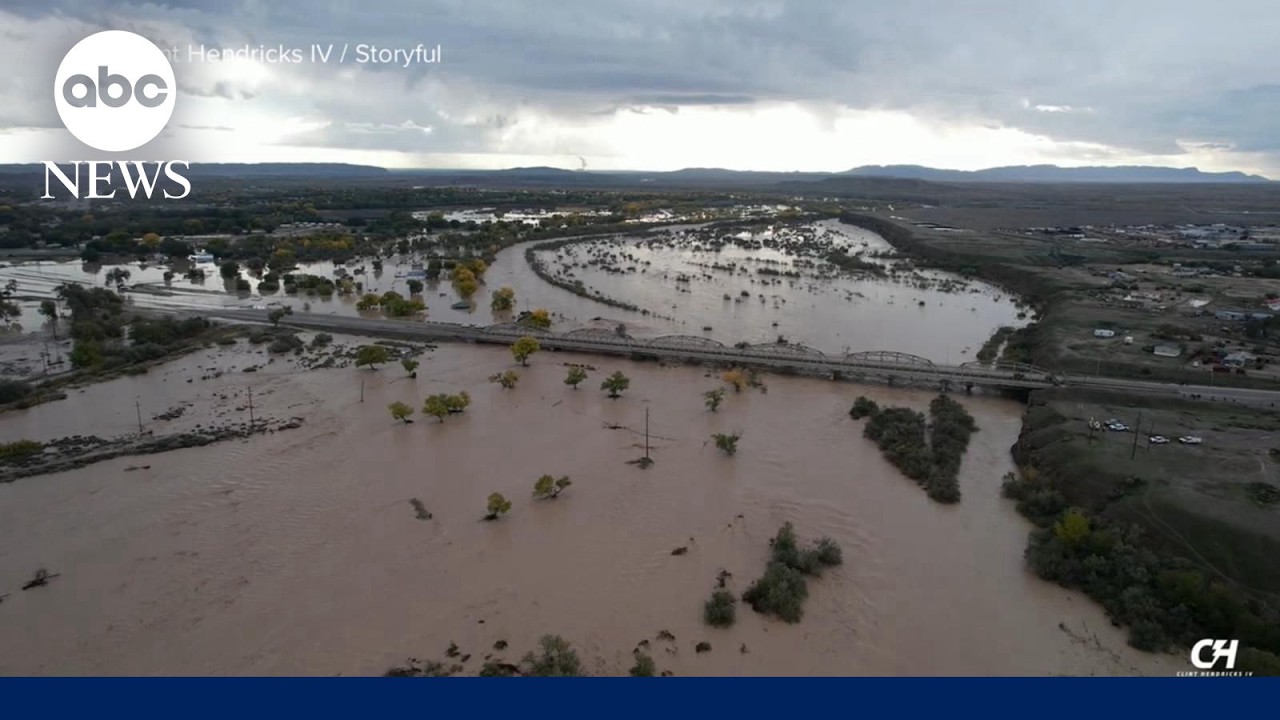
Evacuations ordered in Farmington, Bloomfield and San Juan County

Severe flooding forced hundreds of residents from their homes.

Event Overview

A powerful Pacific storm system caused severe flooding across the Four Corners region, impacting New Mexico, Colorado, Utah, and Arizona. In New Mexico, floodwaters from the San Juan and Animas rivers led to mandatory evacuations in Farmington, Bloomfield, and San Juan County.

Emergency response efforts included at least 60 rescues in Farmington, where families were trapped on rooftops. The Navajo Nation police rescued 30 people, while governors in Utah and Colorado issued emergency declarations.

Source facts (10)
1.

Floodwaters from the San Juan and Animas rivers forced hundreds of evacuations in Farmington.

NY Post
2.

At least 60 rescues were conducted in Farmington, including families trapped on rooftops.

NY Post
3.

Farmington Police Chief Steve Hebbe described the flooding as 'once-in-a-generation'.

NY Post
4.

The city of Hurricane, Utah, declared an emergency.

NY Post
5.

Navajo Nation police rescued 30 people.

NPR
6.

Governors in Utah and Colorado issued emergency declarations.
NPR
7.

Colorado deployed the National Guard.

NPR
8.

Meteorologists attribute the rainfall to a slow-moving low-pressure system from the remnants of Hurricane Trudy and El Niño.

NPR
9.

Immediate evacuations were required for Wildhorse Valley, Lee Acres, specific parts of Bloomfield, and all areas along the San Juan and Animas Rivers.

KOAT
10.

Farmington neighborhoods under evacuation include Rancho de Animas, Pryor Lane, and Railroad.

KOAT

Message Distribution

factual relay A 'once-in-a-generation' storm system has caused devastating flooding and mass evacuations across New Mexico, Colorado, and Utah. 100%
12 articles
The Colorado Sun — Southwestern Colorado floods closed critical roadways. Here’s how to get around. - The Colorado Sun
Message

Severe flooding in Southwestern Colorado has closed critical roadways, requiring travelers to use long detours and follow safety precautions.

NBC News — Flood-weary U.S. Southwest eyes forecast for more rain - NBC News
Message

The U.S. Southwest is dealing with devastating floods and significant financial damage while bracing for more predicted rainfall.

NY Post — ‘Once-in-a-generation’ flooding hits Southwest as more expected through the weekend
Message

A 'once-in-a-generation' storm system has caused devastating flooding and mass evacuations across New Mexico, Colorado, and Utah.

NPR — Severe flooding hits Four Corners region, more expected through the weekend - NPR
Message

Record-breaking rainfall and severe flooding have caused widespread devastation and emergency declarations across the Four Corners region, with more storms expected through the weekend.

KOAT — Evacuations ordered in parts of Farmington due to severe flooding - KOAT
Message

Severe flooding in Farmington, Bloomfield, and San Juan County has led to immediate evacuation orders for multiple areas and warnings of contaminated floodwaters.

CBS News — Four Corners region faces more flood threats following days of heavy rain - CBS News
Message

The Four Corners region is bracing for more heavy rain and thunderstorms following days of flooding that caused evacuations and property damage.

The Guardian — US south-west braces for more storms after enduring days of rain and flooding - The Guardian
Message

The south-west US is facing continued flood threats and significant damage following record-breaking rainfall and river surges.

FOX Weather — Southwest faces more severe weather, flash flooding as Colorado Gov. declares state of emergency - FOX Weather
Message

Severe weather, including flash flooding and rare tornado watches, has caused widespread damage and emergency declarations across Colorado, New Mexico, Arizona, and Utah.

The Guardian — Severe flooding in US west triggers rooftop rescues and evacuation orders
Message

Severe flooding and extreme weather in the Four Corners region have caused widespread destruction, necessitating emergency rescues and state-level disaster declarations.

KRQE — Everything you need to know about the flooding in San Juan County and southwest Colorado - KRQE
Message

Emergency officials are providing critical safety information, evacuation updates, and resource locations for residents affected by flooding in San Juan County and southwest Colorado.

KOAT — 'Once in a generation' flood event impacts San Juan County - KOAT
Message

A 'once in a generation' flood event in San Juan County has necessitated large-scale emergency rescues and caused significant property damage and infrastructure failure.

NPR — Southwest flood damage estimates are hundreds of millions for New Mexico alone
Message

Historic flooding across the Four Corners region has caused catastrophic damage, with New Mexico alone facing hundreds of millions of dollars in infrastructure costs.

Editor's Analysis

A collision of extreme weather and systemic vulnerability

The flooding in the Four Corners region is not merely a result of a single storm but a convergence of atmospheric conditions. The remnants of a tropical system brought record moisture to an area where record-warm coastal waters and broader climatic shifts have increased the intensity of such events. This creates a cycle where the volume of rainfall exceeds the capacity of local drainage and river systems.

Beyond the immediate danger of rising water, the crisis extends to public health. The failure of sewage treatment infrastructure introduces raw sewage into floodwaters, turning a natural disaster into a biological hazard. This shift transforms the emergency from a rescue operation into a long-term sanitation and recovery challenge.

Between immediate rescue and the climate lens

Coverage is split between the urgency of the moment and the search for a cause. NY Post and KOAT focus on the immediate logistics of survival, detailing the 60 rescues and specific neighborhood evacuation orders. KOAT provides the most critical utility for residents by identifying the contamination of water supplies, a detail the other outlets omit.

NPR shifts the focus toward the systemic, linking the disaster to human-caused climate change and El Niño. While this provides necessary context, the coverage as a whole lacks a bridge between the scientific cause and the structural failure of the sewage plants. Readers are told why the rain fell and where to evacuate, but not why the infrastructure was unable to handle the surge.

Updates

Oct 28 · President Donald Trump announced federal disaster assistance for New Mexico Updated 20:05

NBC News reported that the flooding caused deaths and that residents in Bluff, Utah, face evacuations and cut-off roads. According to NBC News, President Donald Trump announced federal disaster assistance for New Mexico, with the state required to match 25% of the funds, and Governor Michelle Lujan Grisham estimates that damages in New Mexico could reach $300 million. NPR reported that the San Juan River in Farmington rose 13 feet in 36 hours and that extensive destruction occurred on the Hopi and Navajo reservations. NPR also reported that sewage spills occurred in Arizona and that the state of New Mexico has allocated $8.25 million for response efforts. Local officials warned residents against returning too early due to hazards such as raw sewage and live power lines, according to NPR.

The confirmation of deaths and an estimated $300 million in damages transforms the event from a rescue operation into a large-scale economic disaster [1]. This shifts the focus toward the financial burden of recovery and the role of federal aid.

NPR provides a critical expansion of the crisis's scope by reporting extensive destruction on the Hopi and Navajo reservations and sewage spills in Arizona [1]. This confirms that the biological hazard identified in the first analysis is not limited to New Mexico but is a regional systemic failure.

NBC News and NPR both report on the financial response, but the coverage remains descriptive. They document the cost of damages and the allocation of funds without investigating the structural vulnerabilities of the infrastructure that led to these costs.

Readers should now watch whether federal and state funds are used for simple restoration or for the fundamental infrastructure upgrades needed to prevent future biological hazards and road failures.

Source facts (9)

NBC News reported that the flooding caused deaths.

NBC News

Governor Michelle Lujan Grisham estimates that damages in New Mexico could reach $300 million.

NBC News

President Donald Trump announced federal disaster assistance for New Mexico, with the state required to match 25% of the funds.

NBC News

Residents in Bluff, Utah, face evacuations and cut-off roads.

NBC News

The San Juan River in Farmington rose 13 feet in 36 hours.

NPR

Sewage spills occurred in Arizona.

NPR

Extensive destruction was reported on the Hopi and Navajo reservations.

NPR

Local officials warned residents against returning too early due to hazards such as raw sewage and live power lines.

NPR

The state of New Mexico has allocated $8.25 million for response efforts.

NPR

Oct 27 · Wolf Creek Pass closed indefinitely following torrential rain Updated 02:39

Torrential rain caused over a dozen emergency road closures in Southwestern Colorado, according to The Colorado Sun. The Colorado Sun reports that U.S. 160 and Colorado 151 were severed or damaged by sinkholes and washed-out segments. The Colorado Department of Transportation (CDOT) reported that Wolf Creek Pass is closed indefinitely and is planning emergency repairs and temporary access roads for the most damaged areas.

The severance of U.S. 160 and Colorado 151 by sinkholes indicates that the disaster has moved beyond surface flooding to structural land failure [1]. This expands the scope of the infrastructure crisis from the sewage plants mentioned in the first analysis to the primary transportation arteries of the region.

The Colorado Sun provides a necessary update on the physical isolation of the region by detailing the indefinite closure of Wolf Creek Pass [1]. This confirms that the geographical barriers are now hindering not just rescue operations, but the general movement of people and supplies.

Readers should now watch whether the 'emergency repairs' planned by the Colorado Department of Transportation are temporary patches or fundamental redesigns to handle the increased moisture levels identified as the systemic cause of this event.

Source facts (4)

Torrential rain caused over a dozen emergency road closures in Southwestern Colorado.

The Colorado Sun

U.S. 160 and Colorado 151 were severed or damaged by sinkholes and washed-out segments.

The Colorado Sun

The Colorado Department of Transportation (CDOT) reported that Wolf Creek Pass is closed indefinitely.

The Colorado Sun

CDOT is planning emergency repairs and temporary access roads for the most damaged areas.

The Colorado Sun

Oct 26 · The San Juan River in Farmington surpassed a 1909 record by two feet Updated 19:27

The San Juan River in Farmington surpassed a 1909 record by two feet. Governor Michelle Lujan Grisham reported hundreds of water rescues in New Mexico and stated that no deaths have been reported. Approximately 600 households in Farmington were ordered to evacuate, and several shelters have been opened in San Juan County, New Mexico. San Juan County reports significant mud and silt contamination resulting from sewage plant failures, and Sheriff Shane Ferrari is managing cleanup efforts. Officials confirm municipal tap water remains safe but advise private well owners to test their water. Power outages persist in the region as some floodwaters recede. In Pagosa Springs, heavy rainfall caused river surges, road closures, and the inundation of homes; the town has declared a local state of emergency. In Colorado, Governor Jared Polis declared a disaster emergency in 11 counties, and mandatory evacuations are in effect in South Fork. La Plata County maintains river closures but has no current evacuation orders. In Utah, the town of Hurricane reported damage to at least 130 homes and RVs. Arizona experienced record-high water levels at Moenkopi Wash and helicopter rescues near Rimrock. New Mexico faced its first Tornado Watch in 28 years, with threats of damaging hail and wind continuing into Saturday, while the National Weather Service is surveying suspected tornado damage in Heber, Arizona. The National Weather Service issued a flood watch for Arizona, Colorado, New Mexico, and Utah. CBS News reports the event follows two months of tropical moisture and previous deadly flooding in the region, and meteorologists attribute the severity to saturated ground following two months of heavy rain that ended a summer drought.

The San Juan River surpassing a 1909 record by two feet confirms this is a historic hydrological anomaly [3]. This supports the first analysis that record-warm coastal waters and tropical moisture have fundamentally altered the region's rainfall capacity.

CBS News and The Guardian both identify that sewage plant failures have left behind significant mud and silt contamination [2, 3]. This confirms the transition from a rescue operation to a biological recovery challenge. However, these reports treat the plant failures as a given fact of the disaster rather than investigating the structural vulnerabilities that allowed them to fail.

KRQE provides a critical service for residents by distinguishing between safe municipal tap water and the risks facing private well owners [2]. This level of detail is essential for public health in the wake of sewage contamination.

Readers should now watch for the long-term health impacts of the silt and sewage contamination as floodwaters recede, and whether officials address the infrastructure gap that left the reclamation plants vulnerable to submersion.

Source facts (21)

The National Weather Service issued a flood watch for Arizona, Colorado, New Mexico, and Utah.

CBS News

Heavy rainfall caused river surges, road closures, and the inundation of homes in Pagosa Springs.

CBS News

San Juan County, New Mexico, reports significant mud and silt contamination resulting from sewage plant failures.

CBS News

Power outages persist in the region as some floodwaters recede.

CBS News

The event follows two months of tropical moisture and previous deadly flooding in the region.

CBS News

The San Juan River in Farmington surpassed a 1909 record by two feet.

The Guardian

Governor Michelle Lujan Grisham reported hundreds of water rescues in New Mexico.

The Guardian

No deaths have been reported according to Governor Michelle Lujan Grisham.

The Guardian

San Juan County Sheriff Shane Ferrari is managing cleanup efforts.

The Guardian

Colorado Governor Jared Polis declared a disaster emergency in 11 counties.

The Guardian

Mandatory evacuations are in effect in South Fork, Colorado.

FOX Weather

Pagosa Springs declared a local state of emergency.

FOX Weather

The town of Hurricane, Utah, reported damage to at least 130 homes and RVs.

FOX Weather

Arizona experienced record-high water levels at Moenkopi Wash and helicopter rescues near Rimrock.

FOX Weather

New Mexico faced its first Tornado Watch in 28 years, with threats of damaging hail and wind continuing into Saturday.

FOX Weather

The National Weather Service is surveying suspected tornado damage in Heber, Arizona.

FOX Weather

Several shelters have been opened in San Juan County, New Mexico.

KRQE

La Plata County maintains river closures but has no current evacuation orders.

KRQE

Officials confirm municipal tap water remains safe, but advise private well owners to test their water.

KRQE

Approximately 600 households in Farmington were ordered to evacuate.

The Guardian

Meteorologists attribute the severity to saturated ground following two months of heavy rain that ended a summer drought.

The Guardian

Oct 25 · New Mexico National Guard and State Police conduct at least 60 rescues Updated 15:19

The New Mexico National Guard and State Police conducted at least 60 rescues between Farmington and Bloomfield, using Black Hawk helicopters to hoist residents from rooftops. Resident Aimee Goodday stated she and her family spent 12 hours on her trailer's roof before their rescue. Near Chaco Canyon, rescue teams evacuated an infant experiencing seizures on foot because helicopters were grounded and roads were washed out. The Bloomfield Water Reclamation Plant was shut down after it was submerged, and officials warned about untreated wastewater in the river. Residents are being urged to avoid flooded areas and conserve water as more rain is expected.

The rescue of an infant near Chaco Canyon on foot highlights a critical gap in emergency response. When roads are washed out and helicopters are grounded, the lack of accessible terrain turns a medical emergency into a high-risk manual evacuation [1].

KOAT provided the most essential information by confirming the shutdown of the Bloomfield Water Reclamation Plant. This confirms the first analysis that the disaster has evolved into a biological hazard, as untreated wastewater now flows directly into the river [1].

While the immediate logistics of survival are well-documented, coverage still fails to explain why the water reclamation plant was vulnerable to submersion. The gap remains between the report of the failure and the structural reasons for that failure.

Source facts (5)

The New Mexico National Guard and State Police conducted at least 60 rescues between Farmington and Bloomfield, utilizing Black Hawk helicopters to hoist residents from rooftops.

KOAT

Resident Aimee Goodday stated she spent 12 hours on her trailer's roof with her family before being rescued.

KOAT

Rescue teams evacuated an infant experiencing seizures near Chaco Canyon on foot after roads were washed out and helicopters were grounded.

KOAT

The Bloomfield Water Reclamation Plant was shut down after being submerged, leading officials to warn about untreated wastewater in the river.

KOAT

Residents are being urged to conserve water and avoid flooded areas as more rain is expected.

KOAT

Coverage flow

Coverage volume

10/23 · 5
10/24 · 2
10/25 · 2
10/26 · 1
10/27 · 2

Focus shift

Recommended Reads

News Story

Story: PG&E Implements Public Safety Power Shutoffs

Card 8 of 12 in this story

Show 4 earlier
PG&E Implements Public Safety Power Shutoffs
Oct 13 · 2 outlets
Where it started
First Santa Ana wind event increases Southern California fire risk
Oct 13 · 3 outlets
Brush fire breaks out in Brentwood
Oct 14 · 2 outlets
↳ Follows “First Santa Ana wind event increases Southern California fire risk”
Bryson Fire spreads in western Malibu
Oct 15 · 6 outlets
↳ Follows “Norte fire triggers evacuations in south Orange County”
Norte fire triggers evacuations in south Orange County
Oct 16 · 9 outlets
↳ Follows “First Santa Ana wind event increases Southern California fire risk”
Southern California Weather Shift and Storm Warnings
Oct 18 · 3 outlets
↳ Follows “First Santa Ana wind event increases Southern California fire risk”
Severe Storms Hit Phoenix and Arizona
Oct 22 · 6 outlets
↳ Follows “Tornado strikes Santa Fe”
Evacuations ordered in Farmington, Bloomfield and San Juan County
Oct 23 · 6 outlets · Viewing now
↳ Follows “Severe Storms Hit Phoenix and Arizona”
Tornado strikes Santa Fe
Oct 24 · 1 outlets
↳ Follows “Evacuations ordered in Farmington, Bloomfield and San Juan County”
Authorities order evacuations in southwestern Colorado
Nov 1 · 4 outlets · ⇄ Story: National Weather Service Forecasts Halloween Rain
↳ Follows “Evacuations ordered in Farmington, Bloomfield and San Juan County”
Santa Ana winds increase fire risk in Southern California
Nov 5 · 2 outlets
↳ Follows “First Santa Ana wind event increases Southern California fire risk”
Show 1 later
Runners Hospitalized During Santa Barbara Half-Marathon
Nov 8 · 7 outlets
↳ Follows “Santa Ana winds increase fire risk in Southern California”

Loading comments...