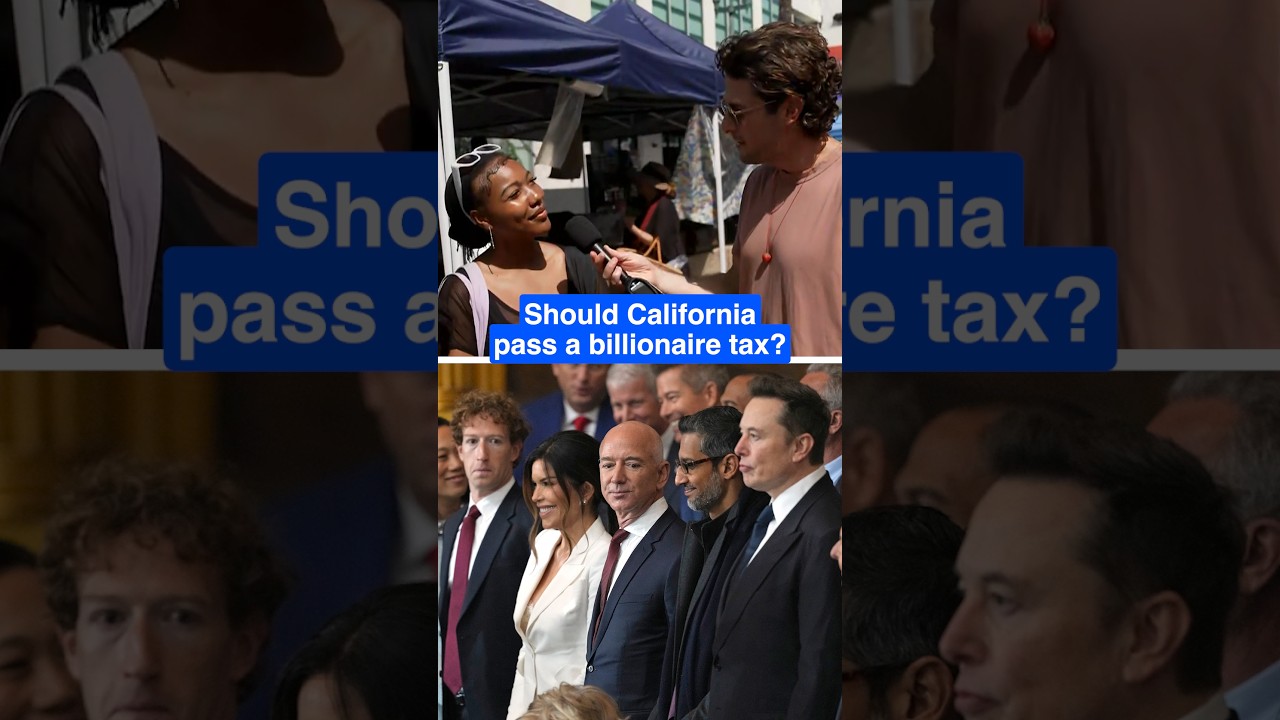
Nov 4 · Proposition 42 proposes a permanent ban on state taxes on personal property and retirement accounts Updated 03:35
Business Insider reports that tech executive Eric Schmidt is among those who have spent millions to oppose Proposition 40. According to Business Insider, a paper by Stanford economists suggests the measure might only raise $30 billion, and Proposition 41 introduces asset prohibitions and auditor reviews in an effort to undermine Proposition 40. CNBC reports that recent polling shows Proposition 40 trailing with 46% support and that opponents have funded a $300 million ad campaign claiming the tax could eventually expand to average citizens. Additionally, CNBC reports that a PAC funded by billionaires opposed to the wealth tax submitted Proposition 42, which proposes a permanent ban on state taxes on retirement accounts and personal property. ABC News reports that Proposition 40 would impose a one-time 5% tax on the wealth of taxpayers and trusts with assets exceeding $1 billion, and that John Doerr is one of the billionaires funding the opposition group Building a Better California. ABC7 reports that the tax would apply to legal residents as of January 1, 2026, and aims to allocate 10% of the raised funds to food assistance and education. Candidate Xavier Becerra opposes the tax, arguing it could drive wealthy residents out of the state and harm California's competitive edge.
The strategy to defeat the wealth tax has shifted from arguing against its fairness to creating legislative traps. By reporting on Proposition 42, CNBC reveals a tactical move to link the billionaire tax to a threat against retirement accounts, effectively turning the general electorate into a shield for the ultra-wealthy.
This development answers the first analysis's question about the tax's viability by showing that the primary threat may not be capital flight, but ballot nullification. If voters pass a permanent ban on personal property taxes to protect their own savings, Proposition 40 becomes legally impossible to implement regardless of its own vote tally.
Business Insider deepens the debate over revenue projections by citing Stanford economists who estimate the tax would raise only $30 billion—far below the $100 billion claimed by proponents. This suggests that the administrative hurdles of asset appraisal identified in the first analysis are not just theoretical risks but are likely to result in a significant revenue shortfall.
ABC News and ABC7 provide broad summaries of the political stakes and funding goals but treat the measure as a high-stakes gamble between redistribution and economic flight. They omit the specific legislative interdependence of the concurrent ballot measures that CNBC and Business Insider highlighted as the primary mechanism for the tax's potential failure.
Readers should now watch whether the $300 million ad campaign succeeds in framing the tax as a slippery slope for average citizens, and whether the legal conflict between Propositions 40, 41, and 42 creates a scenario where the wealth tax is defeated by a separate, more popular measure.
Source facts (12)
Eric Schmidt is among the prominent tech executives who have spent millions to oppose Proposition 40.
Business Insider
Proposition 41 introduces auditor reviews and asset prohibitions as part of its effort to undermine Proposition 40.
Business Insider
A paper by Stanford economists suggests Proposition 40 might only raise $30 billion.
Business Insider
CNBC reported that recent polling shows Proposition 40 trailing with 46% support.
CNBC
Opponents of the tax have funded a $300 million ad campaign claiming the tax could eventually expand to average citizens.
CNBC
Proposition 42 proposes a permanent ban on state taxes on personal property and retirement accounts.
CNBC
Proposition 42 was submitted by a PAC funded by billionaires opposed to the wealth tax.
CNBC
Proposition 40 would impose a one-time 5% tax on the wealth of taxpayers and trusts with assets exceeding $1 billion.
ABC News
John Doerr is one of the billionaires funding the opposition group Building a Better California.
ABC News
The measure aims to allocate 10% of the raised funds to food assistance and education.
ABC7
Candidate Xavier Becerra opposes the tax, arguing it could drive wealthy residents out of the state and harm California's competitive edge.
ABC7
The tax would apply to legal residents as of January 1, 2026.
ABC7
Nov 3 · Fox Business and other outlets report on Proposition 40 funding and economic projections Updated 02:34
Fox Business reports that Proposition 40 aims to fund healthcare, education, and food assistance. UC Berkeley economists argue the tax could raise $100 billion with minimal impact on income tax revenue. Conversely, Hoover Institution researchers claim the tax has already caused a 30% reduction in the tax base due to billionaire departures and estimate a negative net present value of $38.9 billion, suggesting long-term income tax losses will outweigh the one-time gain. Fox Business reports that Larry Page and Peter Thiel have already left California, other billionaires have threatened to do so, and the legislature could potentially amend the tax in the future without voter approval. The Washington Examiner asserts that the tax could result in a large tax bill even if a person's wealth decreased during that year. ABC News reports that recent polling shows a slight majority of voters now oppose the tax, while SEIU United Healthcare Workers West estimates that federal healthcare funding cuts will total $100 billion over five years.
The risk of capital flight has shifted from a theoretical projection to a claim of present reality. Fox Business provides concrete names, such as Larry Page and Peter Thiel, to illustrate the exodus and cites a Hoover Institution study claiming a 30% reduction in the tax base. This directly addresses the first analysis's question about whether the tax can fund services without triggering capital flight by suggesting the damage is already underway.
A new structural risk has emerged regarding the permanence of the tax. Fox Business reports that the legislature could potentially amend the measure without voter approval, suggesting the 'one-time' label may be a political framing rather than a legal guarantee.
Washington Examiner highlights a technical flaw in the tax's design, noting that a tax bill could be triggered even if a person's total wealth decreases during the year. This frames the measure as a confiscatory asset grab rather than a tax on growth.
ABC News identifies a new tactical threat to the measure's survival by reporting on two other ballot measures backed by a wealthy PAC that could nullify Proposition 40 if they pass. This adds a layer of legislative interdependence, where the fate of the wealth tax depends on the outcome of separate, related votes [1].
Readers should now watch whether proponents can provide evidence to counter the claim of a 30% tax base reduction and how they respond to the possibility of the measure being nullified by concurrent ballot initiatives.
Source facts (9)
Proposition 40 aims to fund healthcare, education, and food assistance.
Fox Business
UC Berkeley economists argue the tax could raise $100 billion with minimal impact on income tax revenue.
Fox Business
Hoover Institution researchers claim the tax has already caused a 30% reduction in the tax base due to billionaire departures.
Fox Business
The Hoover study estimates a negative net present value of $38.9 billion, suggesting long-term income tax losses will outweigh the one-time gain.
Fox Business
Larry Page and Peter Thiel have already left California, and other billionaires have threatened to do so.
Fox Business
Fox Business reports that the legislature could potentially amend the tax in the future without voter approval.
Fox Business
The Washington Examiner asserts that the tax could result in a large tax bill even if a person's wealth decreased during that year.
Washington Examiner
SEIU United Healthcare Workers West estimates that federal healthcare funding cuts will total $100 billion over five years.
ABC News
ABC News reports that recent polling shows a slight majority of voters now oppose the tax.
ABC News
Nov 2 · Building a Better California leads opposition to Proposition 40 Updated 08:13
Mother Jones reports that a billionaire-funded group called Building a Better California is leading the opposition against Proposition 40, while proponents intend to use the measure's funds for education and Medicaid. NPR reports that the debate includes whether the measure will survive constitutional challenges and if billionaires can change residency to avoid the retroactive tax, though NPR notes California's AI boom could potentially keep wealthy individuals in the state. Economist Joshua Rauh claims the tax could cost the state $39 billion due to lost income tax revenue and billionaire flight. Generation Tux CEO George Zimmer supports the measure, arguing that taxing the ultra-wealthy is a civic duty based on the ability to pay and that funding for healthcare is needed following federal cuts from the Trump administration's 2025 tax bill. Zimmer asserts that wealthy individuals value California's quality of life over tax rates, citing studies from Washington state and Massachusetts, and claims that it would take 25 years under current law for the loss of billionaire tax payments to equal the $100 billion Proposition 40 would raise, even if all billionaires left the state.
The debate over the tax's viability has evolved into a clash of mathematical models. While economist Joshua Rauh warns of a $39 billion loss due to billionaire flight, George Zimmer argues that the immediate $100 billion gain outweighs the long-term loss of tax payments, claiming it would take 25 years for the exodus to offset the initial revenue [1, 2].
NPR identifies a new variable in the capital flight equation by noting that California's AI boom could act as a tether, keeping wealthy individuals in the state despite the tax burden [1]. This suggests that the state's unique economic ecosystem may mitigate the structural risks of residency changes identified in the first analysis.
Coverage remains divided between the moral imperative of civic duty and the technical risks of constitutional challenges and tax avoidance [1, 2]. While The Guardian focuses on the ethical argument for taxing the ultra-wealthy to recover federal healthcare cuts, NPR engages more deeply with the legal hurdles and the contested assumptions about billionaire behavior [1, 2].
Readers should watch whether the proponents' claim that the tax is a one-time necessity for healthcare is undermined by the legal debate over whether the measure can survive constitutional scrutiny.
Source facts (9)
Proponents intend to use the funds from Proposition 40 for Medicaid and education.
Mother Jones
A billionaire-funded group called Building a Better California leads the opposition against the tax.
Mother Jones
Economist Joshua Rauh claims the tax could cost the state $39 billion due to billionaire flight and lost income tax revenue.
NPR
NPR reports that the debate includes whether billionaires can change residency to avoid the retroactive tax and if the measure will survive constitutional challenges.
NPR
NPR notes that California's AI boom could potentially keep wealthy individuals in the state despite tax pressures.
NPR
George Zimmer, CEO of Generation Tux, supports Proposition 40 and argues that taxing the ultra-wealthy is a civic duty based on the ability to pay.
The Guardian
George Zimmer claims that the funding for healthcare is needed following federal cuts from the Trump administration's 2025 tax bill.
The Guardian
George Zimmer asserts that wealthy individuals value California's quality of life over tax rates, citing studies from Massachusetts and Washington state.
The Guardian
George Zimmer claims that even if all billionaires left California, it would take 25 years under current law for the loss of their tax payments to equal the $100 billion Proposition 40 would raise.
The Guardian
Nov 1 · LA Times reports opponents of Proposition 40 have outraised proponents Updated 19:35
The LA Times reports that opponents of Proposition 40 have significantly outraised proponents in funding and that recent polling shows a shift in public sentiment against the tax. Sports agent Leigh Steinberg is among the opponents. Opponents claim the tax will create an uneven playing field between in-state and out-of-state professional sports team owners and warn that it will increase ticket and concession prices for professional sports. According to the LA Times, the impact of the tax on professional sports team owners depends on whether they are deemed official state residents. In Fortune, economists Owen Zidar and Eric Zwick argue that reforming Proposition 13, which caps property taxes, would be a more efficient way to raise revenue than targeting billionaires. Zidar and Zwick estimate that matching Texas's average property tax rate would more than double residential property tax revenue and lower home prices by approximately 13%. Experts Laura Tyson and Lenny Mendonca suggest focusing on capital income and corporate taxes instead of a wealth tax, noting that several billionaires have already left California in anticipation of the tax.
LA Times identifies a new vulnerability in the tax's design by highlighting how professional sports team owners may avoid the levy based on residency status. This expands the first analysis's concern over capital flight to include legal residency loopholes, suggesting that the tax's reach is limited by the state's ability to define who is an official resident.
The warning that the tax could lead to higher ticket and concession prices shifts the narrative from a fight over billionaire wealth to a direct cost for consumers. By framing the tax as a burden on sports fans, opponents are attempting to erode the public support that previously focused on the moral imperative of funding healthcare.
Fortune provides a structural alternative to the wealth tax by reporting that reforming Proposition 13's property tax caps could more than double residential property tax revenue and lower home prices by 13%. This shifts the debate from how to tax the ultra-rich to whether broadening the general tax base is a more efficient fiscal strategy than targeting a volatile minority [1].
Readers should now watch whether the disparity in funding between opponents and proponents translates into a more aggressive campaign to frame the tax as a 'hidden tax' on the general public, and if proponents can provide a counter-argument to the property tax reform alternative.
Source facts (10)
Sports agent Leigh Steinberg is among the opponents of Proposition 40.
LA Times
Opponents warn that the tax will increase ticket and concession prices for professional sports.
LA Times
Opponents claim the tax will create an uneven playing field between in-state and out-of-state professional sports team owners.
LA Times
The impact of the tax on professional sports team owners depends on whether they are deemed official state residents.
LA Times
Opponents of Proposition 40 have significantly outraised proponents in funding.
LA Times
LA Times reports that recent polling shows a shift in public sentiment against the tax.
LA Times
Economists Owen Zidar and Eric Zwick argue that reforming Proposition 13, which caps property taxes, would be a more efficient way to raise revenue than targeting billionaires.
Fortune
Owen Zidar and Eric Zwick estimate that matching Texas's average property tax rate would more than double residential property tax revenue and lower home prices by approximately 13%.
Fortune
Experts Laura Tyson and Lenny Mendonca suggest focusing on capital income and corporate taxes instead of a wealth tax.
Fortune
Laura Tyson and Lenny Mendonca note that several billionaires have already left California in anticipation of the tax.
Fortune
Oct 30 · Proposed tax on fortunes over $1 billion intended to fund Medicaid Updated 17:00
TIME reports that the proposed tax on fortunes over $1 billion is intended to fund Medicaid. An author in TIME argues that the wealth of billionaires such as Elon Musk and Sergey Brin stems from 'brologarchy,' which the author defines as privatizing rewards from technologies originally funded by public research, including SpaceX, Siri, and GPS. The author proposes 'pre-distribution,' a system where public investments include royalties or equity stakes from the outset to create a 'citizens' dividend.'
TIME introduces a conceptual shift by arguing that taxing existing wealth is a retrospective fix for a deeper structural problem. By coining the term 'brologarchy,' the author claims that the fortunes of tech billionaires are not merely products of entrepreneurship but are built on the privatization of rewards from publicly funded research [1].
This perspective moves the debate beyond the first analysis's question of whether a wealth tax can realistically generate revenue. It suggests that the focus should shift from redistribution to pre-distribution, where the state secures equity or royalties at the start of public investments to prevent the socialization of risk and privatization of reward [1].
While other reports have focused on the administrative viability of the tax or corporate workarounds, TIME is the only outlet to challenge the premise of wealth creation itself. Readers should now watch whether this argument for a 'citizens' dividend' gains traction as a policy alternative to the one-time levy, or if it remains a theoretical critique of the tech industry's relationship with the state.
Source facts (3)
The proposed tax on fortunes over $1 billion is intended to fund Medicaid.
TIME
An author in TIME argues that the wealth of billionaires like Elon Musk and Sergey Brin stems from 'brologarchy,' which they define as privatizing rewards from technologies originally funded by public research such as GPS, Siri, and SpaceX.
TIME
The author in TIME proposes 'pre-distribution,' where public investments include equity stakes or royalties from the outset to create a 'citizens' dividend.'
TIME
Oct 24 · BBC reports polling data for Proposition 40 Updated 04:35
The BBC reports that current polling shows 45% of the electorate are in favor of Proposition 40 and 42% are opposed. The BBC also reports that similar wealth taxes in Europe have largely fallen out of favor due to administrative issues and investment suppression.
The narrow gap in polling reported by BBC suggests the electorate is nearly split on the measure's viability. This division reflects the tension between the immediate appeal of healthcare funding and the structural risks of capital flight and revenue loss discussed in previous reports.
BBC provides a broader historical context by noting that similar wealth taxes in Europe fell out of favor due to administrative issues and investment suppression. This adds a global precedent to the first analysis's question about whether a targeted wealth tax can effectively fund services without triggering negative economic side effects [1].
However, BBC treats the measure as a binary ideological choice. It omits the specific corporate workarounds and inter-union frictions that emerged in more detailed reporting from other outlets.
Readers should watch whether the narrow polling lead for proponents holds as the election nears, or if the specific risks of long-term tax loss and corporate restructuring sway the undecided middle.
Source facts (2)
Current polling shows 45% of the electorate are in favor of Proposition 40 and 42% are opposed.
BBC
Similar wealth taxes in Europe have largely fallen out of favor due to investment suppression and administrative issues.
BBC
Oct 23 · Meta creates non-voting Class C shares Updated 10:12
Fortune reports that Mark Zuckerberg owns 13% of Meta, though his Class B shares provide 61% of the voting control. Meta's board created a new class of non-voting Class C shares to allow Zuckerberg to sell economic stakes for potential taxes without losing voting power. Meta officially claims the new stock class is primarily for capital raising and financing AI growth, while acknowledging it prolongs Zuckerberg's control.
Fortune provides a concrete example of how billionaires may neutralize a wealth tax without relocating. By reporting that Meta created non-voting Class C shares to allow Mark Zuckerberg to liquidate economic stakes without eroding his 61% voting control, the outlet reveals a corporate structural workaround to the tax [1].
This development directly addresses the first analysis's concern regarding capital flight. It suggests that the risk is not only that billionaires will leave the state, but that they will reengineer their asset ownership to maintain power while paying the levy. This shifts the focus from the physical mobility of the wealthy to the legal mobility of their voting rights [1].
Readers should now watch whether other major corporations in California adopt similar share structures. If this becomes a trend, the tax may succeed in raising revenue but fail to challenge the concentration of corporate power, as the financial cost is decoupled from the loss of control.
Source facts (3)
Mark Zuckerberg owns 13% of Meta, but his Class B shares provide 61% of the voting control.
Fortune
Meta's board created a new class of non-voting Class C shares to allow Mark Zuckerberg to sell economic stakes for potential taxes without losing voting power.
Fortune
Meta officially claims the new stock class is primarily for capital raising and financing AI growth, while acknowledging it prolongs Zuckerberg's control.
Fortune
Oct 22 · CNBC reports polling and prediction market data for Proposition 40 Updated 09:27
CNBC reports that recent polling shows narrow leads for 'Yes' votes, while prediction markets suggest a likely defeat for Proposition 40. According to CNBC, legal experts are debating the effectiveness of residency laws in preventing tax avoidance and the feasibility of valuing illiquid assets.
CNBC brings the debate back to the administrative hurdles identified in the first analysis by reporting on legal experts' doubts over valuing illiquid assets and the strength of residency laws. This returns the focus to the practical enforceability of the tax, moving beyond the ideological and numerical clashes of previous days [1].
The divergence between polling and prediction markets suggests that while the public may be swayed by the immediate goal of healthcare funding, professional speculators are betting on the structural risks of capital flight. This gap highlights the tension between the measure's political appeal and its perceived economic viability [1].
Readers should now watch whether the legal arguments regarding asset valuation lead to specific challenges or amendments to the proposal, as the state's capacity to appraise wealth remains the primary bottleneck for actual revenue collection.
Source facts (2)
Recent polling shows narrow leads for 'Yes' votes, while prediction markets suggest a likely defeat for Proposition 40.
CNBC
Legal experts are debating the feasibility of valuing illiquid assets and the effectiveness of residency laws in preventing tax avoidance.
CNBC
Oct 19 · Hoover Institution study estimates Proposition 40 revenue Updated 21:40
The NY Post reported that the intellectual origins of Proposition 40 are linked to economists Emmanuel Saez, Gabriel Zucman, and Thomas Piketty. A March 2026 Hoover Institution study estimates the tax would collect $40 billion, which the NY Post notes is less than half of the $100 billion forecast by supporters. The study further suggests the tax could result in a long-term loss of $24.7 billion in future income tax revenue for California.
NY Post provides a concrete counter-argument to the fiscal viability of the tax by citing a Hoover Institution study. The estimate that the tax would collect only $40 billion—less than half of the $100 billion forecast—directly addresses the first analysis's question about whether the measure can realistically generate the promised revenue [1].
Beyond the immediate collection, the report that the state could lose $24.7 billion in future income tax revenue adds a new layer to the risk of capital flight. It suggests that the long-term fiscal damage could outweigh the one-time gain, shifting the debate from a simple calculation of revenue to a trade-off between immediate funding and future tax stability [1].
While NY Post links the proposal to French economic theories to warn of social instability, it is the only outlet in this round to provide a specific numerical projection to challenge the proponents' claims. Readers should now watch if supporters provide a detailed rebuttal to the Hoover Institution's figures or if the debate remains a clash of ideological forecasts.
Source facts (3)
The intellectual origins of Proposition 40 are linked to economists Emmanuel Saez, Gabriel Zucman, and Thomas Piketty.
NY Post
A March 2026 Hoover Institution study estimates the tax would collect $40 billion, which is less than half of the $100 billion forecast by supporters.
NY Post
The Hoover Institution study suggests the tax could result in a long-term loss of $24.7 billion in future income tax revenue for California.
NY Post
Oct 18 · Proposition 40 vote scheduled for November 3 Updated 10:13
The vote on Proposition 40 is scheduled for November 3. The measure was crafted by SEIU-United Healthcare Workers West to offset federal healthcare cuts from President Trump's 'One Big Beautiful Bill Act'. Dave Regan of the SEIU argues the tax is necessary to recover $100 billion in healthcare funding lost due to federal cuts under the Trump administration. The measure is supported by Sen. Bernie Sanders and Rep. Ro Khanna, and received significant funding from a former aide to Rep. Alexandria Ocasio-Cortez. Nvidia CEO Jensen Huang expressed a willingness to pay the tax, viewing his wealth as a privilege of the American dream. Governor Gavin Newsom and former Congresswoman Katie Porter argue the tax is flawed and encourages wealthy residents to leave the state; Newsom advocates for a federal wealth tax to prevent billionaires from fleeing to states like Florida. Opponents include Republicans, Planned Parenthood, the California Teachers Association, the California State Council of Laborers, and United Domestic Workers. Opponents within labor unions argue the tax lacks long-term sustainability and disproportionately benefits the healthcare sector over education and public safety. SEIU California has taken a neutral stance, favoring ongoing revenue streams over a one-time tax. According to the LA Times, SEIU-UHW President Dave Regan allegedly offered to pull the tax from the ballot in exchange for help securing contracts at medical facilities.
The debate has shifted from a general ideological clash over inequality to a specific conflict over sectoral priorities and political leverage. LA Times reveals that the tax is not a unified progressive front but a tool crafted by SEIU-UHW to recover healthcare funding, sparking opposition from other labor unions who fear the healthcare sector will be prioritized over education and public safety.
This internal friction directly addresses the first analysis's question about whether the tax is a genuine fiscal tool. The report that SEIU-UHW leadership allegedly offered to withdraw the measure in exchange for medical facility contracts suggests the tax may be functioning as political leverage rather than a purely fiscal instrument [2].
While CBS News and NY Post focus on the high-level political divide between the 'Squad' and Governor Gavin Newsom, they omit the granular conflict between different labor unions. Only LA Times engages with the structural tension within the labor movement, showing that the risk is not just capital flight, but inter-union fragmentation over the distribution of the projected revenue [2].
Readers should now watch whether the alleged use of the ballot measure as a bargaining chip becomes a central campaign theme, as this would change the measure's meaning from a wealth tax to a labor negotiation tactic.
Source facts (13)
The vote on Proposition 40 is scheduled for November 3.
NY Post
Dave Regan of the SEIU argues the tax is necessary to recover $100 billion in healthcare funding lost due to federal cuts under the Trump administration.
CBS News
Governor Gavin Newsom and former Congresswoman Katie Porter argue the tax is flawed and encourages wealthy residents to leave the state.
CBS News
Nvidia CEO Jensen Huang expressed a willingness to pay the tax, viewing his wealth as a privilege of the American dream.
CBS News
The measure was crafted by SEIU-United Healthcare Workers West to offset federal healthcare cuts from President Trump's 'One Big Beautiful Bill Act'.
LA Times
The California State Council of Laborers and United Domestic Workers oppose the measure.
LA Times
Opponents within labor unions argue the tax disproportionately benefits the healthcare sector over education and public safety and lacks long-term sustainability.
LA Times
SEIU California has taken a neutral stance, favoring ongoing revenue streams over a one-time tax.
LA Times
Governor Gavin Newsom advocates for a federal wealth tax to prevent billionaires from fleeing to states like Florida.
LA Times
SEIU-UHW President Dave Regan allegedly offered to pull the tax from the ballot in exchange for help securing contracts at medical facilities.
LA Times
The measure is supported by Sen. Bernie Sanders and Rep. Ro Khanna.
NY Post
The measure received significant funding from a former aide to Rep. Alexandria Ocasio-Cortez.
NY Post
Opponents include Republicans, Planned Parenthood, and the California Teachers Association.
NY Post
Oct 17 · Proposition 40 and the Debate Over Corporate Power Updated 03:39
TIME expands the scope of the debate by arguing that taxing billionaires is a symptom-level fix. The author posits that the root cause of inequality is the shareholder-primacy model and concentrated corporate power, which allow wealth to be extracted from labor and the public.
This perspective shifts the focus from the administrative viability of a tax to the structural nature of corporate governance. While the first analysis questioned if a wealth tax could fund services without triggering capital flight, TIME suggests that restructuring corporate ownership and antitrust enforcement are the necessary prerequisites for any redistribution tool to be effective.
Most reports continue to treat the tax as a standalone fiscal or political event. TIME is the only outlet in this round to link the California measure to a broader critique of how corporate lobbying and the decline of unions enable the existence of the ultra-wealthy.